
An Examination of
Manufactured Sameness
Why Uniformity Fails as a Design Strategy
Why I Avoid Using a Matching Room Set in High-Quality Design
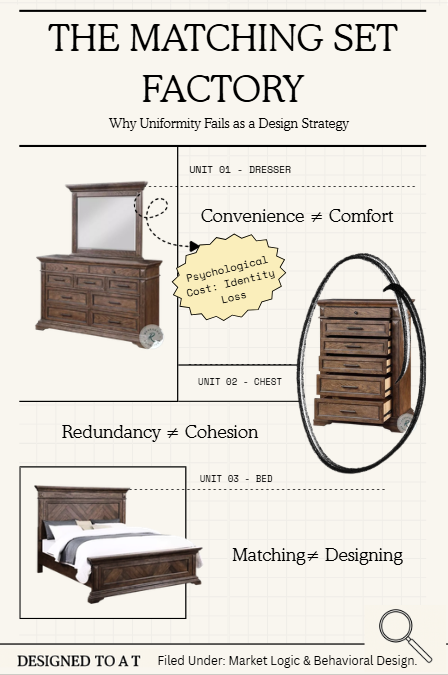
Matching sets — the full bedroom collection with identical bed, dresser, nightstands, mirror, sometimes even the little accent bench — promise an easy kind of cohesion. Everything has the same finish, the same hardware, the same silhouette. On paper it sounds convenient. In reality, it’s one of the fastest ways to make a room feel flat, generic, and mass-produced.
If you ever hire a designer and they install a four-piece matching set from Ashley in your bedroom, run. There’s almost no scenario where that reflects thoughtful design.
But before I explain why matching sets fall short today, it’s important to understand where they came from.
Matching Sets Were Once Luxury
Before furniture was mass-manufactured, having a “matching room” meant something very different. If all your pieces shared the same style, carvings, or finish, it was because:
a single craftsperson built the entire suite
the pieces were designed specifically for the architecture of your home
there was an intentional relationship between each item’s proportions
Cohesion used to be a sign of craftsmanship — not convenience.
Once factories stepped in, the industry realized people wanted “the look” of cohesion without the cost or time. So they created the modern bedroom set: identical pieces sold as a package. A luxury symbol became a shortcut, and as shortcuts usually do, it diluted the meaning of the original thing.
Why Matching Sets Don’t Work Anymore
Our eyes today are trained by Pinterest, boutique hotels, Instagram, designers, and exposure to so many styles that we can immediately spot when something feels “store-bought.” Matching sets fall into that category for a few reasons:
They create visual redundancy — everything repeats the same shape, finish, and height, so nothing stands out. There’s no hierarchy or rhythm.
They erase personality — your room starts to look like a showroom display rather than a lived-in, intentional space.
And because the pieces weren’t chosen for your architecture or proportions, the set often feels heavier or more symmetrical than the room can actually handle.
A room where every piece is the same wood tone is the equivalent of wearing a shirt, pants, jacket, shoes, and bag all in the exact same fabric. It reads as one block. No depth, no contrast, no story.
In today's design world, mixing materials, eras, silhouettes, and finishes is the new indicator of luxury. Cohesion is still the goal, but cohesion now comes from relationships between pieces — not duplication.
If You Already Have a Matching Set
Most people do, and it’s not a tragedy. Matching sets aren’t a design death sentence; they’re just visually heavy. You don’t have to replace everything. You just need to break the repetition.
Focus on modifying or swapping one or two pieces so the eye stops reading everything as one unit. Nightstands are the easiest place to start — when they shift to a different material or silhouette, the entire room opens up. Adding softness through fabric (an upholstered bed, a bench, or layered textiles) also helps break up the wood-on-wood-on-wood effect.
Even changing the styling of the dresser — using asymmetry, taller elements, or a contrasting mirror — can stop it from feeling like a catalog page.
Little changes matter. You’re simply interrupting the “factory set” rhythm so the space can breathe. It's not about throwing everything out or judging your past choices.
Most people collect what they know, what was available, or what felt safe at the time. That doesn’t make their room “bad” — it makes it a starting point.
**Good design isn’t about erasing your taste.
It’s about shaping it.**
You don’t need to replace an entire set to elevate your room.
You just need to introduce variation — one piece that adds contrast, balance, or personality.
**Enhance what you already own.
Balance what feels heavy.
Let your taste evolve instead of restarting from zero.*
If You’re Starting Fresh
When building a room from scratch, think in terms of anchors and accents instead of sets. Choose one piece that leads — usually the bed or dresser — and let the rest support it with variation in shape, texture, or tone. You don’t need four things that match to achieve harmony. You need pieces that speak to each other without repeating themselves.
Good design isn’t about buying cohesion.
It’s about creating it.
The truth is, matching sets are only appealing because they promise certainty. But certainty isn’t the same as sophistication. A room that feels curated, collected, and intentional will always outperform a room that was pre-packaged.
Cohesion is earned — not manufactured.
Enjoy? this
Written and Designed to a T
Share this article!
link link link
Related Articles:
blah blah blah
<!-- Interactive Mood Board Ghost - Image Canvas -->
<div data-ghost data-ghost-plugin-name="mood-board" data-blog-href="/blog-1"></div>
<!-- Mood Board by Ghost -->