
An Examination of
Manufactured Sameness
Why Uniformity Fails as a Design Strategy
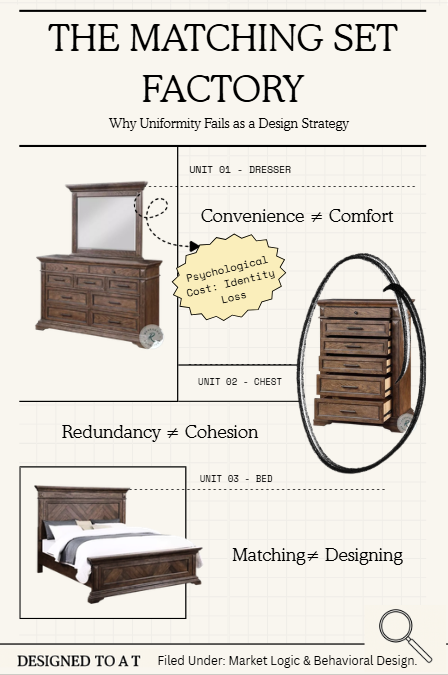
Matching sets — the full bedroom collection with identical bed, dresser, nightstands, etc. promise an easy kind of cohesion. Everything has the same finish, hardware, and silhouette. On paper it sounds efficient and reassuring. The decisions are already made.
In practice, it’s one of the fastest ways to make a room feel flat, generic, and mass-produced because cohesion achieved through duplication resolves the space too quickly.
Before examining why matching sets struggle today, it’s worth understanding where they came from.
Matching Sets Were Once Luxury
Before industrial manufacturing, having a “matching room” meant something very different. If all your pieces shared the same style, carvings, or finish, it was because cohesion used to be a sign of craftsmanship — not convenience.

As mass production entered the picture, the industry recognized an opportunity: people wanted the appearance of cohesion without the cost or time it once required. The modern matching set was born , designed to simulate the harmony that had once emerged from craftsmanship. A luxury symbol became a shortcut, and as shortcuts usually do, it diluted the meaning of the original thing.
Why Matching Sets Don’t Work Anymore
Matching sets fail today not because they’re cohesive, but because they are overly resolved.
Our visual literacy has changed. We are trained by Pinterest, boutique hotels, design media, and lived experiences that favor contrast, layering, and variation. As a result, we can immediately sense when a room hasn’t required much interpretation.

When every major piece repeats the same material, shape, and finish, the eye reads the room as a single object rather than a collection of relationships. There’s nothing left to unfold. No tension, no hierarchy, no pause.
In today's design world, mixing materials, eras, silhouettes, and finishes is the new indicator of luxury. Duplication creates unity through certainty. Relationship creates unity through intention.
If You’re Starting Fresh
When building a room from scratch, think in terms of anchors and accents, not sets.
Choose one primary piece to lead — often the bed or dresser — and allow the supporting elements to vary in material, shape, or tone. You don’t need four matching pieces to achieve harmony. You need pieces that respond to each other without repeating themselves.
Good design isn’t about buying cohesion.
It’s about creating it.
The truth is, matching sets are only appealing because they promise certainty. But certainty isn’t the same as sophistication. A room that feels curated, collected, and intentional will always outperform a room that was pre-packaged.
Cohesion is earned — not manufactured.
If You Already Have a Matching Set
Matching sets aren’t a design dead end; they’re just a base. You don’t have to replace everything. You just need to break the repetition.
Balance what feels heavy.
Let your taste evolve instead of restarting from zero.
The goal isn’t replacement. It’s interruption.
Swapping or modifying just one or two pieces can change how the entire room is perceived. Introducing softness through upholstery, textiles, or layered bedding can also relieve the wood-on-wood effect common in sets.
Even styling choices matter. Asymmetry, vertical elements, or a contrasting mirror can prevent the space from reading like a catalog spread.
What Certainty Can’t Produce
Matching sets remain appealing because they promise certainty. The outcome feels guaranteed. The decisions are simplified.
But certainty isn’t the same as sophistication.
Rooms that feel curated, collected, and intentional consistently outperform rooms that were pre-packaged — not because they’re more expensive, but because they reveal thought, choice, and authorship.
Cohesion isn’t something you purchase.
It’s something you earn.
Enjoy? this
Written and Designed to a T
Share this article!
link link link
Related Articles:
blah blah blah